
The Drawing Machine
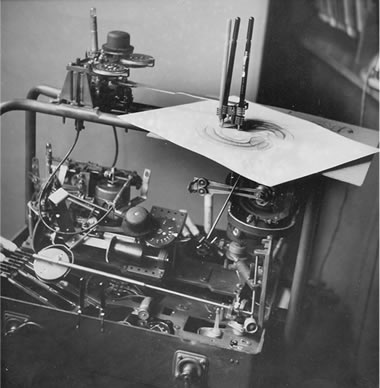
Desmond Paul Henry’s drawing machine is a mechanical device that can be programmed to draw complex patterns and designs. It is considered one of the earliest examples of algorithmic art, which is art created using algorithms, or mathematical formulas.
Henry’s drawing machine consists of a series of pens and gears that are controlled by a computer program. The program can be used to specify the path of the pens, the speed at which they move, and the amount of ink they deposit. This allows Henry to create a wide range of artworks, from simple geometric patterns to complex abstract designs.
Henry’s drawing machine was groundbreaking in its ability to create art that was not possible to create by hand. It also helped to pave the way for the development of digital art and computer graphics. Today, Henry’s work continues to inspire artists around the world, and his drawing machines are held in collections by museums around the world.
The artworks demonstrate Henry’s mastery of his drawing machine and his deep understanding of mathematics. They are also visually stunning and thought-provoking.
Henry’s drawing machine is a significant example of the intersection of art, technology, and mathematics. It is a testament to Henry’s creativity, ingenuity, and passion for art.
The drawing machine was indeed a modified device. He repurposed a World War II bombing sight computer to create the core of his machine. This bombsight computer, which used analog mechanisms to calculate the trajectory of bombs, provided Henry with the mechanical components he needed to control the movement of his pens.
By combining the bombsight computer with other components, such as motors, gears, and electrical circuits, Henry created a machine capable of producing complex and dynamic drawings. He did not simply modify the bombsight computer; he used his knowledge of engineering and mechanics to transform it into a powerful tool for artistic expression.
How did the artist invent the machine? Did he modify an existing device?
- Input: The machine received input in the form of punched paper tape, which contained instructions for the movements of the pens.
- Processing: The punched paper tape was read by a photoelectric reader, which converted the holes in the tape into electrical signals.
- Output: The electrical signals were then used to control the motors and gears, which in turn moved the pens across the paper.
Henry’s invention was truly innovative, as it allowed him to create art that was impossible to achieve by hand. His use of a repurposed bombsight computer demonstrates his resourcefulness and ingenuity, while his intricate understanding of mechanics and engineering allowed him to create a machine that was both powerful and precise.
Here are some of the advantages of using the bombsight computer as the base for his drawing machine:
- Robustness: The bombsight computer was a well-engineered device designed to withstand the rigors of wartime use. This made it ideal for use in a drawing machine, which would need to be able to run for hours on end.
- Accuracy: The bombsight computer was designed to be incredibly accurate, which was essential for Henry’s artistic purposes.
- Versatility: The bombsight computer could be programmed to perform a wide range of tasks, which gave Henry a great deal of creative freedom.
Overall, Desmond Paul Henry’s drawing machine was a remarkable invention that pushed the boundaries of art and technology. By modifying a World War II bombsight computer, he created a machine capable of producing stunning and complex artworks. His invention continues to inspire artists and technologists today.
