What is Cartesian dualism?
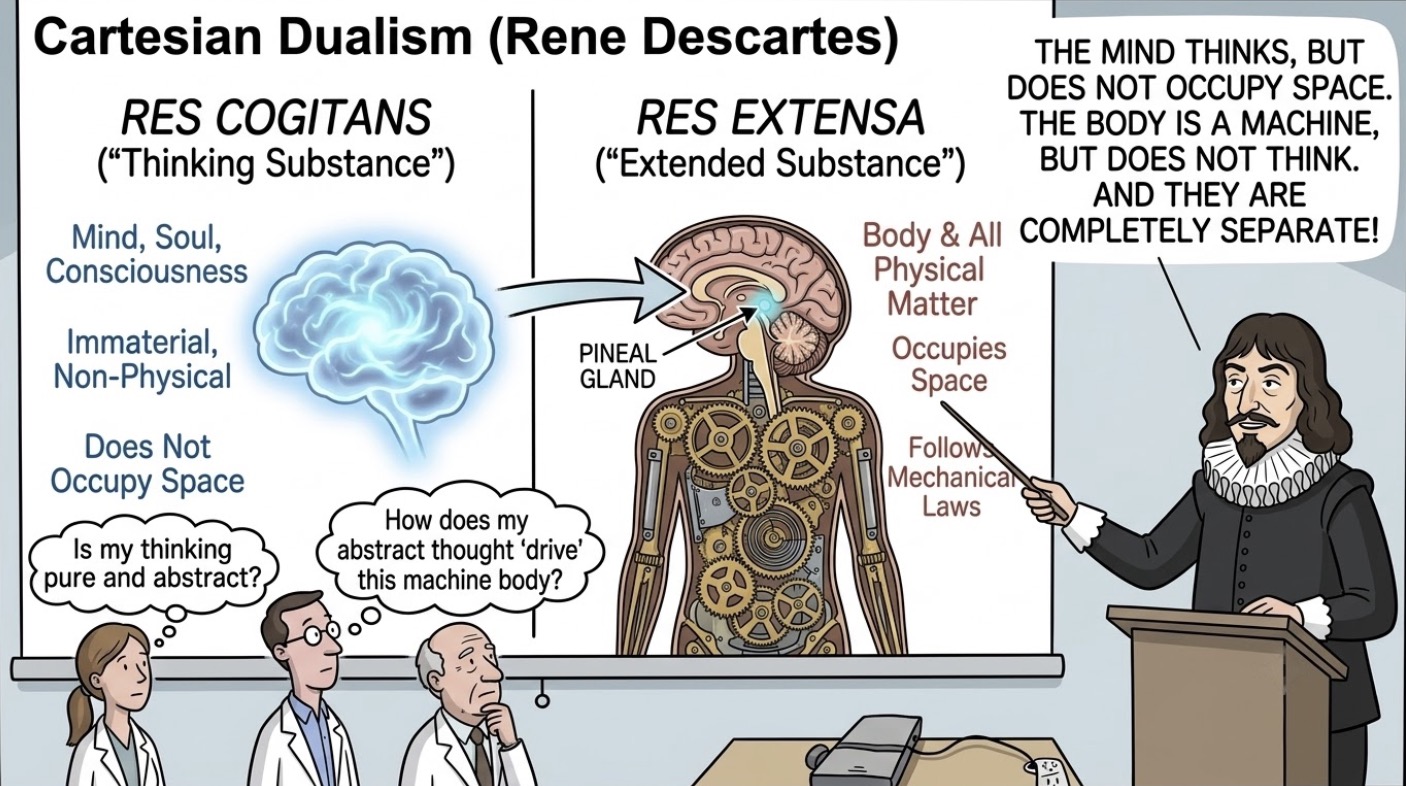
Cartesian dualism is the philosophical view proposed by René Descartes (hence “Cartesian”) in the 17th century. It holds that reality consists of two fundamentally different kinds of substance:
-
Res cogitans (“thinking substance”) — the mind, soul, or consciousness. This is immaterial, non-physical, and does not occupy space.
-
Res extensa (“extended substance”) — the body and all physical matter. This occupies space and follows mechanical laws.
For Descartes, the mind and body are completely separate things. The mind thinks but has no physical location or extension; the body is a machine but does not think. A human being is an unlikely union of the two, with the mind somehow “driving” the body (he speculated through the pineal gland).
The key inheritance from this view is a sharp split between intellect/reason and body/matter — the idea that genuine intelligence is something abstract, pure, and independent of the physical, flesh-and-blood world.