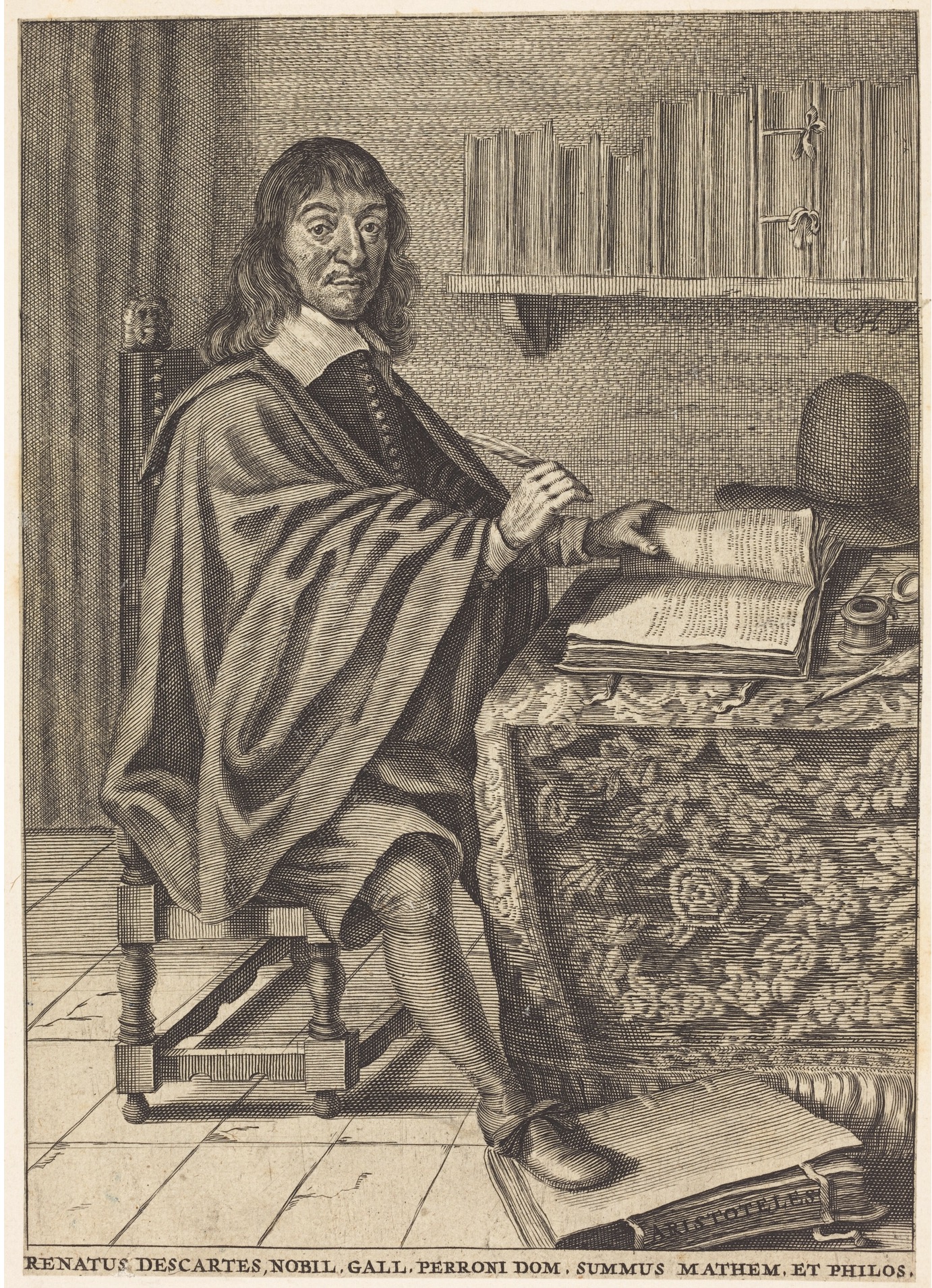
He played a major role in the 17th-century Scientific Revolution by bridging algebra and geometry, while laying the foundational framework for Western rationalism.
Key Contributions
1. The Cartesian Coordinate System (Mathematics)
Descartes invented analytic geometry, which connects algebra and geometry. By introducing orthogonal axes—what we now call the Cartesian plane ( and coordinates)—he made it possible to represent geometric shapes with algebraic equations and vice versa. This laid the direct groundwork for Isaac Newton and Gottfried Wilhelm Leibniz to invent calculus.
2. “Cogito, Ergo Sum” (Philosophy)
In his landmark works Discourse on the Method (1637) and Meditations on First Philosophy (1641), Descartes set out to find absolute certainty by doubting everything that could possibly be doubted (known as Cartesian doubt).
He realized that even if an all-powerful deceiver was fooling all his senses, he must still exist as a conscious entity to be deceived in the first place. He summarized this fundamental truth as:
“Cogito, ergo sum” — “I think, therefore I am.”
3. Mind-Body Dualism
Descartes argued that reality consists of two distinct types of substance:
-
Res cogitans (thinking substance): The non-physical mind or soul.
-
Res extensa (extended substance): The physical body and material world.
This concept, known as Cartesian Dualism, shaped centuries of debate in metaphysics, cognitive science, and the philosophy of mind regarding how a non-physical mind interacts with a physical body.